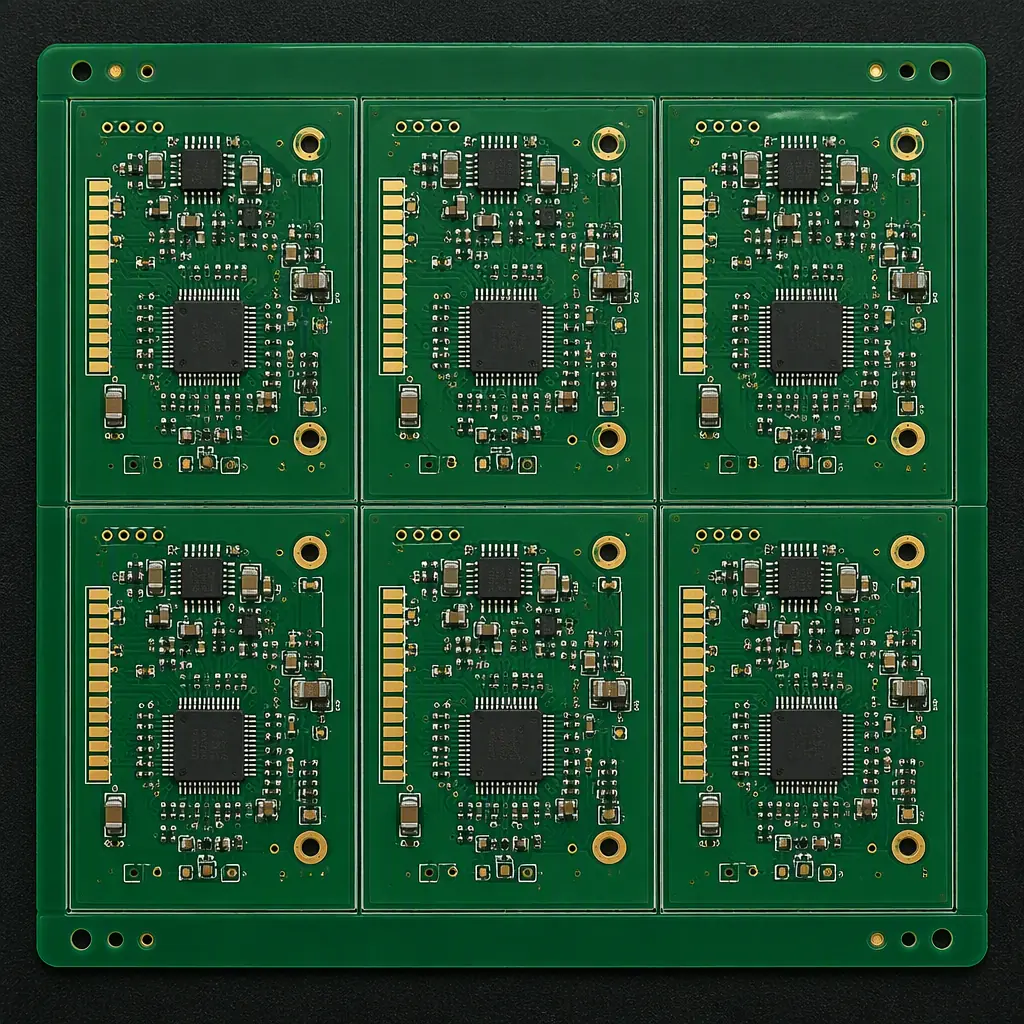
Depanelization — also called singulation or depaneling — is the process of separating a multi-up panel into individual boards after the components are placed and soldered. The panel is built that way for efficiency: one panel goes through stencil printing, pick-and-place and reflow as a single unit, then is cut apart. The cut method is the variable. V-score, router routing and laser cutting each apply different amounts of mechanical stress, dust and heat, and the difference shows up directly in board-level yield. At Huaxing PCBA we assemble on 8 SMT lines with 8M placements/day, run IATF 16949 and ISO 9001-certified processes, and we singulate everything from standard rigid FR-4 to rigid-flex. See our panelization and box-build guides.
This guide compares the three main methods — V-score, tab routing and laser routing — and helps you read a panel and pick the method your board actually needs, based on board shape, substrate, component density and edge quality requirement.
The Three Methods and How Each Works
| Method | How it cuts | Best for | Main draw-back |
|---|---|---|---|
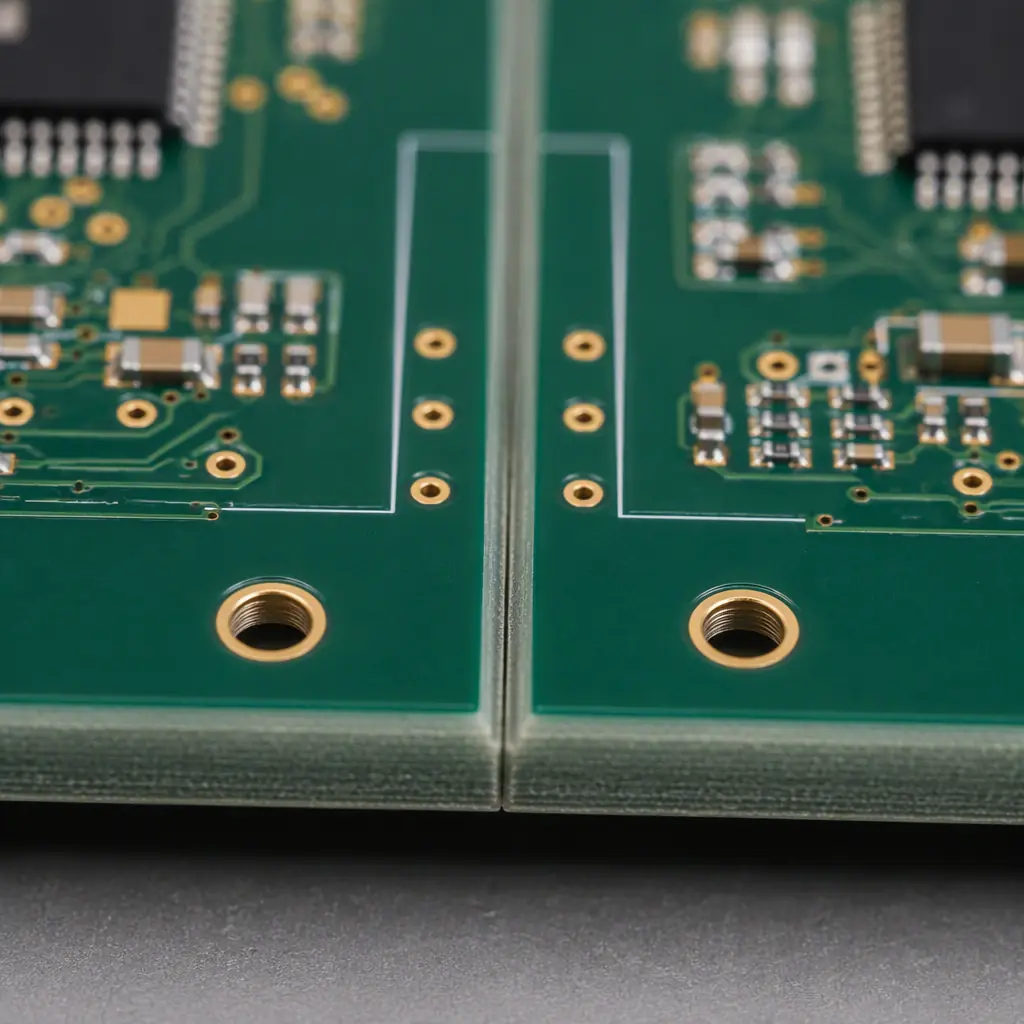
| V-score (V-cut) | Router blade cuts a V-groove ~1/4–1/3 of board thickness; boards break along the score | Straight-edge, high-volume rigid boards | Only straight lines; boards can bend or crack if the break is forced |
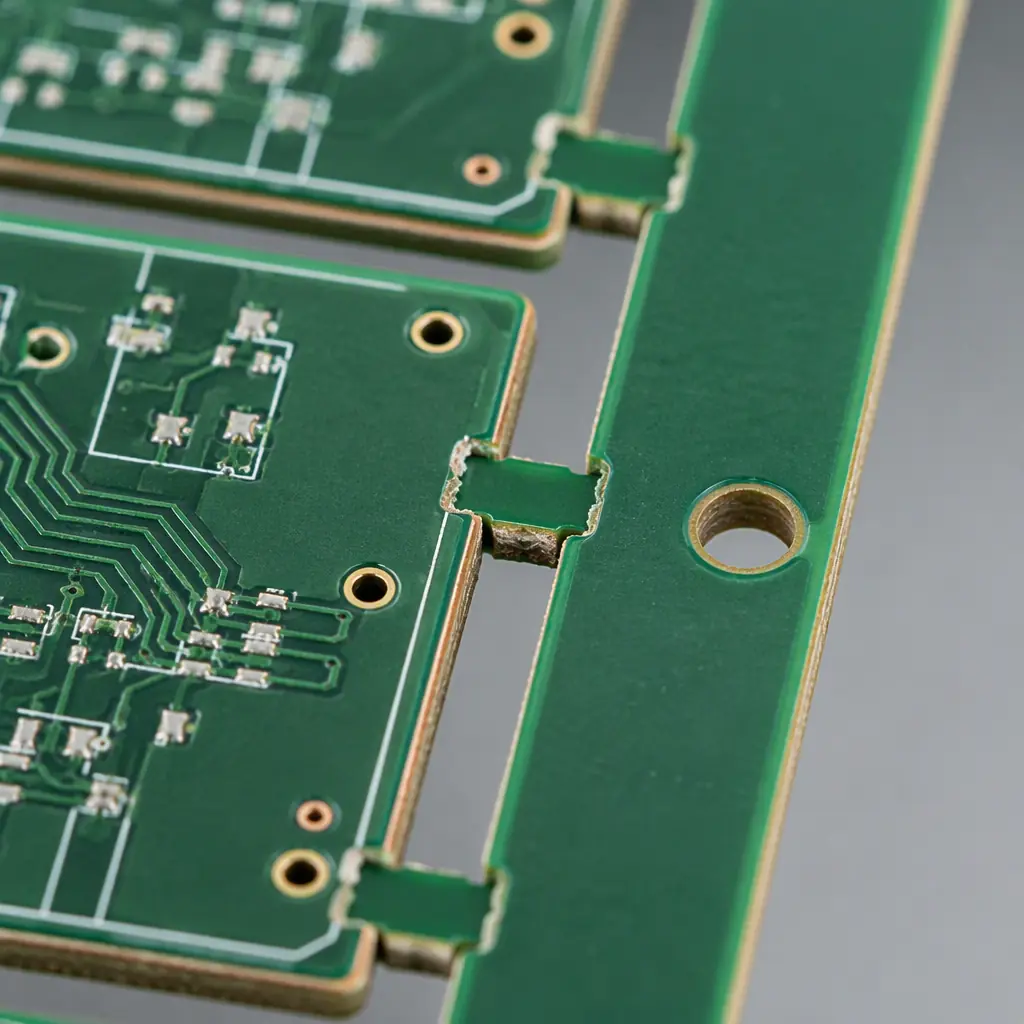
| Tab routing (router) | A router bit cuts channels and leaves small tab-bridges (mouse bites) | Irregular shapes, mixed boards, dense arrays | Slower, produces dust; tabs need a secondary snap-off |
| Laser routing | A laser vaporises the material, no mechanical force | Flexible and rigid-flex, fragile components, tight edges | Slower and higher cost per board |
Each method trades throughput, edge quality and mechanical risk. The right choice depends on what you cannot afford to damage — not just on what is cheapest per panel.
V-Score: Fast and Cheap, but Only for Straight Edges
V-score is the workhorse of high-volume rigid-board singulation. The board is pre-scored during fabrication with a V-shaped groove in the panel, and after assembly the boards are snapped apart along that score. The groove typically removes about 0.3 mm to 0.4 mm of a 1.6 mm board, leaving the rest to hold the two sides together until the break — roughly one third of the thickness depth. The score runs the full length of a straight edge.
V-score is fast and inexpensive, which is exactly why it is used on most consumer and industrial boards with straight board outlines. But it has two hard limits. First, it can only follow straight lines, so it cannot singulate an L-shaped, round or heavily profiled board. Second, the break applies bending force to the assembly, so it is risky close to heavy components, large BGA clusters or any solder joint at the board edge. If the score is not deep enough, or the board is forced too hard, you get cracked laminate, lifted pads or grey-board (glass fibre showing).
Key Takeaway: If your board outline is straight and the components stop well back from the edge, V-score is the cheapest and fastest option. If you have parts near the score line or an irregular outline, move to routing.
Tab Routing: Flexible Shapes and Better Edge Quality
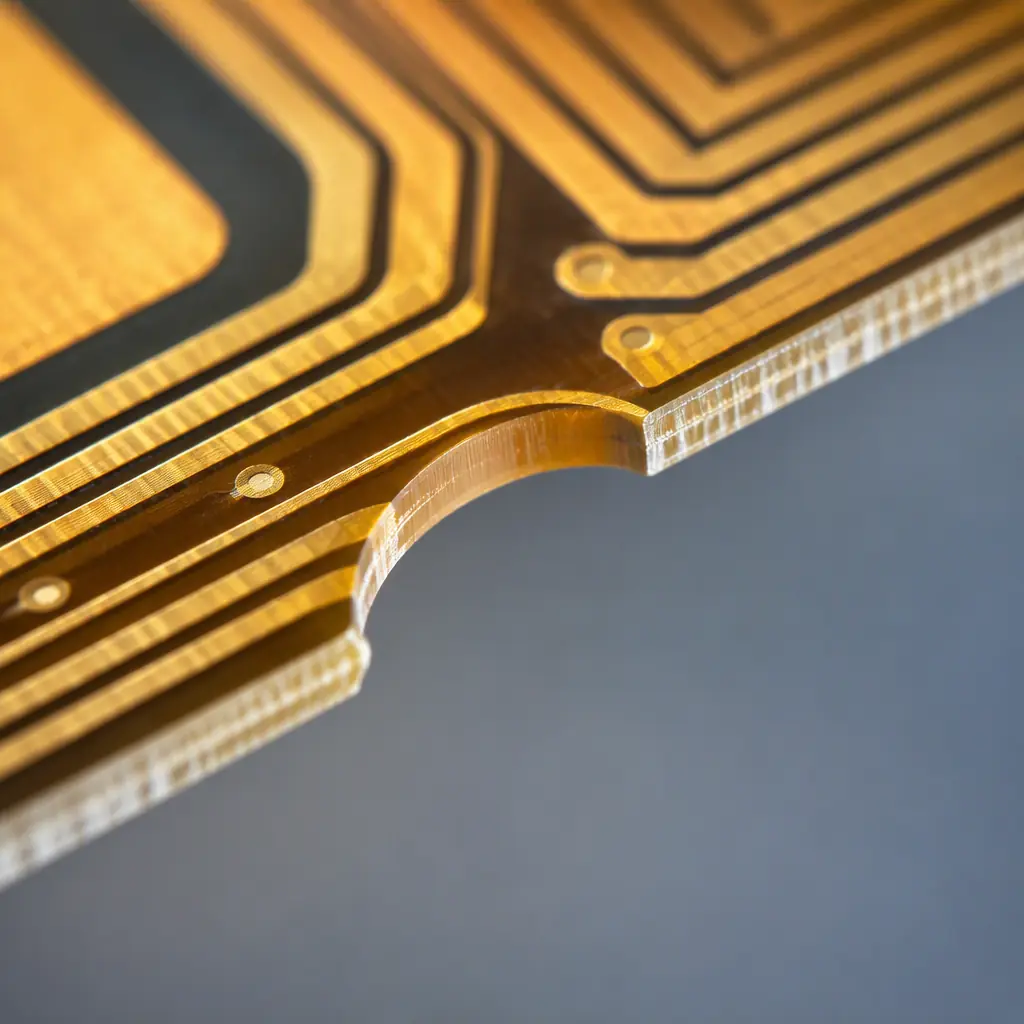
Tab routing uses a router bit to cut the profile of each board, leaving small bridges — tabs, often called mouse bites — to hold the board in the panel until the final snap. The tabs are typically 0.5 mm to 1.0 mm wide and sit in a defined location, spaced so the board does not flex during handling or reflow. After the router pass, a secondary operation breaks the tabs and the board is free.
Routing handles any board shape, gives a clean green edge, and is the default for irregular outlines and for boards with components close to the panel edge. The trade-offs are cycle time and dust. Routing is slower than V-score per linear millimetre, and it produces glass-and-copper dust, which must be vacuumed away so it does not contaminate the assembly. If a routed channel runs over a soldered area, the cut can also transmit vibration into neighbouring joints.
Our panel utilization and nesting guide explains how to design the tabs and the routing path so the boards hold together during reflow but separate cleanly at the end of the line.
Laser Routing: Zero Mechanical Stress for Flexible and Fragile Boards
Laser depanelization vaporises the board material along the cut line without touching the board. Because there is no router bit and no bending force, it is the safest option for flexible and rigid-flex boards, and for boards with components or fine traces right at the cut edge that a mechanical method would crack.
Laser cutting yields the cleanest edge and eliminates the dust and mechanical shock of the other methods, which is why it is the default for flex circuits and thin, warpage-prone substrates. The costs are speed and cost per unit: laser is the slowest and most expensive per board, so it is reserved for the boards that cannot tolerate a mechanical method. If you are singulating a flexible circuit, this is usually the method to specify — see our rigid-flex guide for the substrate side.
Choosing the Method: A Decision Guide
Select the depanelization method from the board's constraints, in this order — substrate, board shape, then component proximity to the edge.
Flexible or rigid-flex? Use laser.
Any board that is flexible or thin will crack under a V-score break or a router cut. Specify laser routing to avoid mechanical stress.
Irregular shape? Use tab routing.
V-score only does straight edges. For an L-shape, a round profile or a mixed panel, route the outline and leave tabs.
Straight edge and components set back? Use V-score.
If the outline is straight and no component or heavy joint sits near the score, V-score is the cheapest.
Components very close to the cut edge? Use laser.
Even a routed board can transmit vibration into a joint near the cut line. If the part is literally at the edge, an edge-connector or castellation design changes the geometry — see our edge plating guide.
Depanelization and Your Specification: What to Put on the RFQ
Depanelization method, tab location and permissible edge condition should be stated in the assembly specification, because they affect both cost and inspectability. A buyer who leaves it unstated gets the fabricator's default, which is usually the cheapest — and may not be what the board needs. See our specification & RFQ guide for the full handoff.
- State the method — V-score, tab routing or laser, explicitly.
- Define tab size and position — so the boards separate cleanly and no tab lands under a component.
- Set the edge condition — clean trim for a visible edge, or bare-glass grey edge if a V-score break is acceptable.
- Flag flexible or fragile substrates — so the assembler never blindly applies a mechanical method.
Cost and Yield: The Real Trade-Off
Cost is the opposite of safety across the three methods. V-score is cheapest per board and fastest — but only safe for straight rigid boards. Tab routing adds cost per board and cycle time but handles any shape. Laser routing is the most expensive per board but is the only method that is safe for flexible, thin and edge-dense boards. The effective cost is not the per-board price of the cut — it is the total cost including the rework and yield loss from cracked boards and damaged joints. A slightly more expensive cut that avoids a 1% singulation scrap rate is usually the cheaper overall choice.
Summary: Match the Cut to the Board, Not to the Price
Depanelization is the last step on a populated board, and it is the one most likely to damage the work you just finished. Choose V-score for straight rigid boards with components set well back from the edge; tab routing for irregular shapes and denser arrays; laser routing for flexible, rigid-flex and edge-dense boards. State the method, tab and edge condition in your specification, and let the board's geometry and substrate decide — not the cheapest quote.
At Huaxing PCBA we build IATF 16949 and ISO 9001 certified boards with heavy copper, flex and rigid-flex, HDI and up to 32 layers, and we assemble and singulate on 8 SMT lines with 8M placements/day, X-ray and AOI inspection. We can advise the best depanelization method for your board and quote it accurately. Get a quote or ask our engineering team about panel and singulation.